Showing posts with label George Pérez. Show all posts

Friday, June 28, 2019

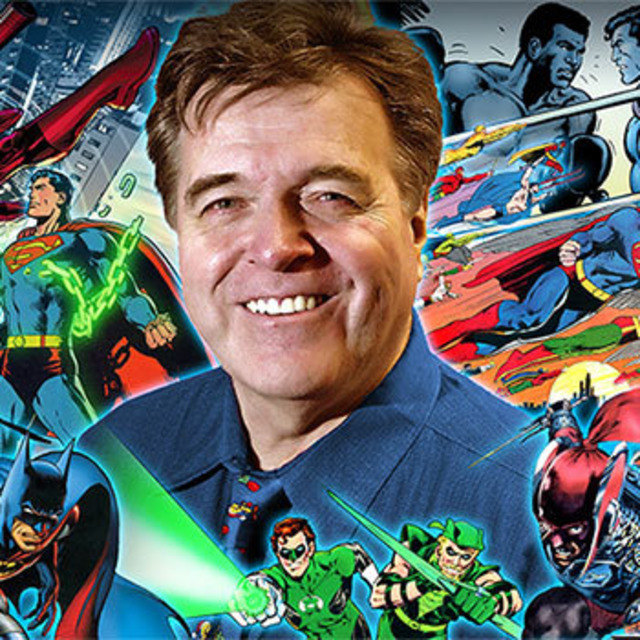
Happy Birthday, George Pérez From the Deathstroke Files!

Deathstroke's legendary co-creator,
George Pérez
Today, the Deathstroke Files celebrates the 65th birthday of Deathstroke the Terminator's legendary co-creator, George Pérez. Pérez's storied comics book career began in 1974 for Marvel Comics' black-and-white magazine imprint, Curtis Magazines, in the horror title Monsters Unleashed (1973) #8  in the issue's fourth feature; a  14-page story titled, "A Martian Genesis." Much of Pérez's early work was for other Curtis titles including a regular run on Deadly Hands of Kung Fu (1974) and some issues of Unknown Worlds of Science Fiction (1974).

Pérez's actual Marvel Comic's premiere was in Creatures on the Loose (1969) #33, the first of a short five-issue run on the title, but this run opened the door for higher-profile titles like The Inhumans (1975), The Avengers (1963), and the Fantastic Four (1961). Pérez became a Marvel mainstay for the next five or so years adding a comic book adaptation of the film, Logan's Run (1976) and a six-month stint on the team-up book Marvel Two-in-One (1974) to his already impressive résumé.

By 1980, Pérez was taking penciling jobs from Marvel's "distinguished competition," DC Comics, the first of which was a Firestorm back-up tale, "Firestorm Is Back in Town," from The Flash (1960) #289. But it was Pérez's second DC job that signaled the project that would his legacy as one of the most influential comic book artists in the history of the medium. DC Comics Presents (1978) #26 would play host to the debut of Pérez and writer Marv Wolfman's seminal creation, the New Teen Titans. But in addition to the New Teen Titans' soon to be released series, Pérez was also penciling,  The Avengers for Marvel Comics and Justice League of America (1960) for DC Comics at the same time.

The following month would witness the launch of one of DC Comic's most important titles ever with The New Teen Titans (1980) #1. This watershed comic figuratively exploded in popularity, eventually outselling the reigning sales champion, Marvel Comic's Uncanny X-Men (1963), making DC Comics a serious threat to Marvel's long-standing industry dominance. Of major importance to this blog, The New Teen Titans #2 gave birth to a certain "world's greatest assassin," Deathstroke the Terminator, who served as the premier antagonist in the series' apex story arc, "The Judas Contract."

After departing from the Teen Titans' titles, Pérez and Wolfman would again collaborate on the genre-changing maxi-series, Crisis on Infinite Earths (1985), which altered the foundations of the DC Comics Universe as well as signaling an end to comics' Bronze Age. Following Crisis, Pérez would redefine and reinvigorate a Golden Age classic for the new post-Crisis era with Wonder Woman (1987) #1. Pérez would return to Marvel to pencil the now classic Infinity Gauntlet (1991) (though he departed the series midway through issue #4 due to creative differences), the alternate future tale Hulk: Future Imperfect (1992), and the Epic Comics series Sachs and Violens (1992).  The remainder of Pérez's was spent bouncing around many different publishers for projects like Malibu Ultraverse's Ultraforce (1994), a Marvel Comics relaunch of The Avengers (1998), a truncated creator-owned project for Image Comics in George Perez's Crimson Plague (2000), CrossGen Chronicles (2003) and Solus (2003) for CrossGen Entertainment, the intercompany crossover JLA/Avengers (2003), DC Comics' New 52 relaunch of Superman (2011), and his creator-owned George Perez's Sirens (2014) for Boom! Studios.

Pérez announced his retirement from comic book work in early 2019 due to vision complications from diabetes, but he has already established a body of work worthy of any comic book industry hall of fame. Happy birthday, George Pérez!

Thursday, June 13, 2019

Super-Team Family #2614: Deathstroke vs. Daredevil!

Despite occupying competing fictional realities, DC Comic's Deathstroke and Marvel Comic's Daredevil seem like they would mesh together well in a tradition super-hero/super-villain relationship. So much so that the were literally combined in Amalgam Comics' Assassins (1996) in the form of Dare the Terminator. Ross Pearsall from Super-Team Family: The Lost Issues blog agrees with this notion as one of his recent homages cover pits the "world's greatest assassin" against the "man without fear" with the fate of Jericho in the balance in Super-Team Family #2614, "The Trial of Joseph Wilson." 

This, of course, is a "rematch" from Super-Team Family #2377 and features art from superstar pencilers, Deathstroke's legendary co-creator, George Pérez and Klause Janson of Daredevil (1964) and Batman: The Dark Knight Returns (1986) fame. If you like the work that Pearsall is doing on Super-Team Family: The Lost Issues, please consider donating to his Patreon by clicking on this link to help make it possible for this fun labor of love to continue.


Wednesday, June 12, 2019

The Deathstroke Files Remembers the Tragedy at Pulse.

Image Source: IDW
In the world of comic books, violence is glorified. Whether it is a thunderous right hand from Superman, a slash of the sword by Wonder Woman, or a boot to the face by Batman superhero comics depend on violence to drive their action and, in many cases, to resolve the narrative conflict. The "good guys" win, "evil" is punished, and all is well...in comic books. I've yet to encounter a case where the fantasy, fictionalized violence, which only appears literally within the pages of a comic book has resulted in any real-life bloodshed (damned paper cuts notwithstanding).

When real-world violence occurs it is always tragic. While narrow definitions classify civil authorities as "good guys" (and the majority truly are), and the authors of violence as "bad guys," whether or not the "evil" is punished resolves nothing for the victims of violence whose lives are fundamentally changed (if not ended) or for the family members of those who were needlessly murdered. Just knowing that the "bad guy" has died or been captured doesn't instantly help these people cope with their new, and profoundly different realities. And unlike the fantasy world of comic books, people in the real world don't return from the grave. They are gone; forever.

But a funny thing happened after the horrendous shootings at the Pulse night club on June 12, 2016. The fantasy worlds of comic books and the all-too-real one merged in a way that sought to bring some much-needed relief to the survivors of the attack and to those who lost loved ones because of it. Veteran comic book writer, Mark Andreyko organized a 144-page anthology masterpiece from IDW, with assistance from DC Comics, called Love is Love that featured works by some of not only comic book heavyweight talent, but also some pretty big names from Hollywood. Comic book giants like Grant Morrison, Brian Michael Bendis, Jim Lee, Gail Simone, G. Willow Wilson, Tom King, and Deathstroke's legendary co-creator George Pérez joined forces with literary masters such as J.K. Rowling and Brad Meltzer in addition to TV and film folk like Matt Bomer, Patton Oswald, Taran Killam, Morgan Spurlock, and Wonder Woman (2017) director Patty Jenkins. All of these brilliant professionals and hundreds more volunteered their time and their tremendous talents to produce this anthology, with all of its sales proceeds going to help the Orlando tragedy's survivors and the families of the deceased in their long and challenging recovery.

Characters from all over the wide and varying landscape of fiction appeared in support of those affected by the tragic events at Pulse. Superman, Batman, Wonder Woman, Catwoman, Nightwing, Batwoman, Harley Quinn, Archie Andrews, Kevin Keller, Betty Cooper, Veronica Lodge, the Spirit, Cassie Hack, Apollo, Midnighter, assorted Green Lanterns, Harry Potter, Albus Dumbledore, Hermine Granger, and Ron Weasley coming together to support consensual love in all its forms. But one feature character that seemed completely out of place at first was none other than Deathstroke the Terminator. Deathstroke's views concerning violence and death seem ill-fitted to the anthology's themes of love, tolerance, and acceptance rather than the cruel, cold violence normally associated the Slade Wilson. But the one-page story (posted below), penned by SNL alumnus, Taran Killam, injects Slade with a dose of humanity, albeit a very temporary one.

Written by Taran Killam, Art by Barry Crain

The Deathstroke Files remembers the victims, survivors, and family members who were forever changed by the horrific events at the Pulse night club. For those of you who have not yet purchased this beautiful anthology and still wish to help, Love Is Love is still available at many comic book retailers, book stores, Amazon.com, and Comixology.

Tuesday, June 11, 2019

DEATHSTROKE BY: Jericho by Phil Cho

Given both that it's Pride Month and his upcoming roles in both Deathstroke (2016) as well as the greater DC Comics' "Year of the Villain" mega-event, I thought that it would be appropriate to spotlight Jericho in this edition of DEATHSTROKE BY. With that said, the U.S. artist, and huge DC Comics fan, Phil Cho is doing some really interesting work, many examples of which appear in his DeviantArt gallery. Cho's Jericho piece (posted below) is from a larger commissioned series that features many characters from the Wolfman and Pérez era of the Teen Titans. The full body portrait depicts Joseph Wilson in full, classic super-heroic gear with his trademark black and green eye effects indicating that the viewer is about to experience a rather weird couple of minutes. Cho's art style is reminiscent of that which is used in animation cells utilizing color shading rather than the standard comic book line shading the effect of which adds a sense of motion to an otherwise static super-hero pose. Hats off to Phil Cho for a nice bit of art dedicated a much-underappreciated character.

Saturday, May 25, 2019

Cyborg From 1985's Who's Who #5

Regardless of specific comic book continuity, Victor Stone, aka Cyborg, became the symbolic embodiment of the future's promise to overcome the challenges and tragedies of today through the continued advancement of knowledge and technology. Even though he was created in 1980, it's apropos that a character born of state-of-the-art technology has really come into his own in the twenty-first century. Two years before the real world's Jarvik 7 artificial heart was implanted in a human, Marv Wolfman used cutting-edge technology to reconstruct over half of Victor Stone's body following a catastrophic lab explosion at S.T.A.R. Labs. Now, in a world of routine artificial hip replacements, cochlear implants, and voluntary embedding of microchips in the human body, a character like Cyborg seems more prophetic that fictional.

Even though he has been associated with other superhero groups, like the Doom Patrol or more recently the Justice League, Cyborg will be forever linked with the New Teen Titans. Cyborg lengthy tenure with the began with the team's revival, putting him squarely on a collision course with the original Ravager, Grant Wilson, and his father, Deathstroke the Terminator. In fact, Grant's first ever act as the Ravager from New Teen Titans (1980) #2 was an attack on Cyborg, from which he needed an unexpected assist from the Terminator to avoid defeat. This event made Cyborg the first Teen Titan to cross figurative swords with Deathstroke. Posted below is a scan from Cyborg's 1985 Who's Who entry from issue #5 (V) featuring art by both Deathstroke's and Cyborg's legendary co-creator, George Pérez, and Romeo Tanghal.

Art by George Pérez and Romeo Tanghal

Tuesday, May 21, 2019

Funko Dorbz 2 Pack: Nightwing and Deathstroke

When I post about Deathstroke-related merchandise, I like to focus newer items or even ones that have yet to be released because older pieces tend to be increasingly entangled in the "eBay Effect" of artificial price inflation that plagues the secondary market. The eBay Effect really kicks in when the merchandise has a limited production run or has an exclusive retail availability. Funko had entered into many such arrangements with WalMart, Target, and Toys "Я" Us leading to some exclusive figures fetching ridiculous prices in the online aftermarket. 

Now imagine a collectible that was only available for sale at a convention, only 1,500 of them were made, and was only on sale for four days. OUCH! Logic and history tell us that such an item would bring hundreds, if not thousands of dollars online. But what if I told you that I have routinely found this item of eBay for as low as $20.00 USD? Brand new, the Funko Dorbz 2 Pack: Nightwing and Deathstroke sets were sold exclusively at the 2017 San Diego Comic-Con, and had only a limited 1,500 unit production run. Exclusive availability, short availability time, and a microscopic production run should have sent this item through the secondary market's figurative roof, but this item can still be acquired at a more-than-reasonable price by the savvy collector.


There are some other aspects of this set worth noting. While there are other versions of Nightwing available in the Dorbz collection, this set is the only way to get Nightwing in his original George Pérez designed "Judas Contract" era costume, which debuted in Tales of the Teen Titans (1980) #44. Furthermore, this two-pack set contains the only version of Deathstroke currently in the Funko Dorbz line. So if you ever wanted a semi-rare Deathstroke collectible, but were never willing to take out a second mortgage, the Funko Dorbz 2 Pack: Nightwing and Deathstroke set is a great way to make it happen without breaking the bank.

Wednesday, May 15, 2019

Wondergirl 1987 Who's Who Entry From Issue #26

Here is a scan of the 1987 Who's Who entry from issue #26 (XXVI) for the original Donna Troy Wonder Girl. Wonder Girl was a member of the first iteration of the Teen Titans, joining the team in The Brave and the Bold (1955) #60 and was a founding member of the team's Marv Wolfman and George Pérez New Teen Titans' revival squad that first crossed swords with Deathstroke the Terminator. Wonder Girl's Who's Who entry featured original art by New Teen Titans' legend, George Pérez.

Sunday, May 5, 2019

The Deathstroke Files Celebrates Cinco de Mayo With Spanish Who's Who (Quien es Quien) Profiles

¡Feliz Cinco de Mayo! To commemorate this Mexican (and increasingly American) holiday I thought that it would be cool to repost some Deathstroke-related Who's Who entries, but this time en Español. Much like the Mexican army at the first Battle of Puebla, all of the Who's Who entries below, with art by the legendary George Pérez, are real winners. ¡Por favor, disfruta!


This Who's Who entry is certainly a fan edit, but I posted it anyway.

Sunday, April 28, 2019

DEATHSTROKE COVERED: New Teen Titans (1980) #34 By the Legendary George Pérez

The cover for New Teen Titans (1980) #34 is amazing in multiple ways. First, it is a prime example of a trademark George Pérez multi-character scene. Secondly, it is jarringly symbolic as it clearly illustrates Deathstroke's desire to terminate the Teen Titans. Thirdly, this comic marked only the fifth ever appearance of Deathstroke, still commonly referred to as "Terminator," and, despite his popularity with fans, Deathstroke had not appeared in New Teen Titans in two years, though Chris Claremont and Walt Simonson did use him for Marvel and DC Present: The Uncanny X-Men and the New Teen Titans (1982) #1. 

And lastly, (bear with me here as I admit that this one is a stretch) if one looks at the cover as a photograph taken in the middle of an in-progress action, Deathstroke is firing at the Titans from the viewer's left to right. If the action continued along that path it is reasonable to assume that all of the Titans would be struck by Deathstroke's gunfire. That is, all of the Titans except one. Raven, Robin, and Kid-Flash had not yet been shot because the line of fire had yet to reach them. But the line of fire had already passed through Terra, and she had not been shot. In a certain context, this cover foreshadows the yet-to-be-revealed relationship between Deathstroke and Terra as well as Terra's role as a mole within the group as the reason she was not shot on the cover (I know, it sounds a little conspiracy theorist on my part, but it was fun to speculate). Anyway, the cover is posted below and as always, for best viewing results, open the image into its own tab.

Art by the Legendary George Pérez

Friday, April 19, 2019

TOOLS OF THE TERMINATOR: Deathstroke's Power Staff

Deathstroke's Power Staff as a melee
weapon.
Art by Mick Zeck
From Deathstroke the Terminator's very first panel in New Teen Titans (1980) #2, we were introduced to his two signature weapons. One was his sword, the Deathstroke, from which he took his professional name (more on the Deathstroke sword can be found by clicking this link). His other trademark weapon was his multi-purpose/multi-function, Power Staff. 

Deathstroke's telescoping Power Staff was a regular part of the Terminator's arsenal in his earliest years, but it was curiously missing during his sometimes chaotic New 52/DC You continuities. Depending on the era and the writer, the Power Staff is constructed of either the super-metal, Promethium, or, according to current Deathstroke scribe, Christopher Priest, some type of Titanium alloy.

Deathstroke regularly wields the Power Staff much like a traditional bo staff for close-quarters melee combat against a single opponent. In addition, the Power Staff can be disassembled to form two smaller battle staves, similar to the ones used by Nightwing. But when the staff is assembled it is also good for maintaining a manageable combat distance when battling against waves of multiple opponents.

The Battle Staff can also be used for tactical maneuvering. By taking advantage of his superhuman strength and agility, Deathstroke can use his Power Staff to pole vault over tall fences or to quickly scale walls or stairs. However Deathstroke utilizes the Power Staff in up-close combat, it means a horrible headache for someone.

But it is called a Power Staff for a reason. That reason is that in addition to its multitude of melee capabilities, Deathstroke's Power Staff is also capable of firing destructive energy blats from either end. If Deathstroke finds himself outnumbered by triple-digits, the Power Staff can fire bolts of energy in two directions allowing him to take out large numbers of opponents in quick order. As shown in the image below, the Power Staff's energy blasts are powerful enough to take down a military-grade helicopter. Furthermore, the blasts are capable of temporarily holding off the likes of Superman and Green Lanterns. Needless to say, Deathstroke's Power Staff is capable of some major firepower.

Deathstroke's Power Staff as a powerful firearm.
Art by Steve Erwin

Deathstroke has also made efficient use of his Power Staff when battling against various DC Universe speedsters. Speedsters, particularly Wally West, seem to be especially vulnerable to being tripped at high speeds and crashing with devastating results as illustrated in the image below. Deathstroke used his own enhanced reflexes and combat expertise to hurl the Power Staff entangling Kid Flashes legs and taking him out of the picture. Years later, after West had assumed his uncle Barry Allen's identity as the Flash, Deathstroke appeared to be making his escape with West in hot pursuit. As West rocketed around a corner, he was met with Deathstroke's Power Staff against his shins resulting in a severe crash. A new super-hero identity, but the same old Wally.

Deathstroke's Power Staff used to take down Kid Flash, Wally West
Art by George Pérez.

Though we don't see it as much as we used to, Deathstroke's Power Staff is as synonymous with the Terminator as his trademark bifurcated mask. Whether used as a melee weapon or an energy blaster, the Power Staff is capable of doing a major amount of damage no matter who wields it. But in the deadly hands of Deathstroke the Terminator, the Power Staff could reasonably be considered a weapon of mass destruction.

Wednesday, April 3, 2019

The Changeling (Beast Boy) Entry from 1985's Who's Who #5

Here is a scan of the 1985 Who's Who entry from issue #5 (V) for Gar Logan, fka the Changeling, aka Beast Boy. Gar participated in the reformation of the Teen Titans and was with them for their fateful first contact with the Ravager and Deathstroke the Terminator. He also fell very much in love with Deathstroke's mole in the Teen Titan's, Terra. Following the events of the "Judas Contract," Changeling challenged Slade to a battle to the death due to his involvement in Terra's death. But when Slade arrived for the battle in civilian clothes, instead of fighting one another, he and Gar discussed the issues between them. As a result, the two rivals came to a mutual state of respect.

For best viewing results, open the image below in its own window.

Text by Marv Wolfman
Art by George Pérez and Romeo Tanghal

Thursday, March 21, 2019

The Teen Titans Entry from 1986's Who's Who #23

Deathstroke made his debut in the pages of New Teen Titans (1980) #2 and Slade Wilson has been bound to the teen super-team, in all its subsequent incarnations ever since. Posted below is a scan of the 1986 Who's Who entry from issue #23 (XXIII) for the Teen Titans with art by the legendary, George Pérez. For best viewing results open the image in a new tab.

Art by George Pérez

Tuesday, March 19, 2019

Deadpool and other Deathstroke "Homages"

It is apropos that the phrase, "there is nothing new under the sun," has appeared in a myriad of different sources. One source feeding off of a prior one, changing the wording to fit specific circumstances, but leaving the general meaning intact. This concept can also be applied to works of art, be they visual art, music, literature, or even comic books. Do we have Superman without Hercules or Doc Savage? Does Batman exist in a world without the Scarlet Pimpernel or Zorro? Is there a Darth Vader without Doctor Doom or Darkseid? Jack Kirby didn't think so (Lookin' at you, George Lucas).

Deathstroke is no exception to this phenomenon. Many people point out the similarities between Deathstroke and Marvel Comics' Taskmaster. Given their occupations, color scheme, and George Pérez as a co-creator it seems reasonable that the Taskmaster may have influenced the creation of Deathstroke, though the time between their debuts probably rules that out. I personally see more similarities to Takao Saito's Golgo 13 than the Taskmaster, but that post has already been written.

What can be argued is the Deathstroke has inspired his share of...we'll be diplomatic and call them homages, some of which we will examine here. For the purposes of this post, an homage will have the following characteristics. One, the homage must be a "badass" mercenary that is a master of both melee weapons and firearms regardless of their personality. Two, the homage must have a mostly-full body costume with a completely covered face. And three, a really, really ominous codename that evokes impending death.

The first, and most blatant "homage" was Chris Clairmont and Steve Leialoha's Death-Stroke for Marvel Comics in 1981. More about this "homage" can found in an earlier post by clicking here.

This image just about sums it up.
The second and most obvious (and ridiculously successful) example is Deadpool. Created by Fabian Nicieza and Rob Liefeld in 1991 for Marvel Comics' New Mutants (1983) #98. Though Liefeld still denies it, Nicieza has pretty well confirmed that Deadpool, in his original form, was indeed an homage to Deathstroke, who was a favorite character of the pair (I mean Wade Wilson, really?). Deadpool would eventually morph into his the lunatic, fourth-wall breaking, "merc with the mouth" form we all know today through the subsequent work of writers Joe Casey and Christopher Priest. While I have to admit, I did enjoy both of the Deadpool films, the character itself doesn't really appeal to me. I feel the image to the left accurately captures my take on Deadpool in the form of an old school SAT-style analogy. With that being said, let's move on to the next Deathstroke homage.

Art by Dan Norton and Karl Kesel
Next up is a Deathstroke homage from Homage Studios' Jim Lee and Bandon Choi. Debuting in the pages of WildCATS: Covert Action Teams (1992) #1 was a Kherubim half-breed that threw his lot in with the Daemonite Helspont, the sworn enemy his own people. Pike was Helspont's number one agent of death and destruction against Lord Emp's WildC.A.T.S. team. 

The visual and thematic similarities to Deathstroke are more than obvious. Mercenary? Check. Master of firearms? Check. As comfortable killing you with swords as he is with guns? Check. Battlesuit with a full-face mask? Check. Use of an energy battle staff that can be separated into two smaller staves? Check. Threatening name? Pike, as in "your head on a!" Check. Pike is a stone cold brutal killer that is not beyond turning his back on a lover if she failed to follow his orders. After Flashpoint, Pike found himself in conflict with Katar Hol, the Savage Hawkman. Let's just say that Pike has more than just a passing resemblance to Deathstroke and move on. 

Deathtrap
Art by Juan Ferreyra
Jim Lee and Brandon Choi were not done "homaging" Deathstroke when they created Pike. No, they had one more menacing merc for us in the form of the dastardly Deathtrap. First appearing in Stormwatch (1993) #1, Deathtrap, aka Seamus O'Brienn, was once affiliated with a Northern Irish separatist group during the ethnic and religious conflict from the 1980s and 90s known colloquially as "the Troubles." Deathtrap later became a thorn in the side of Stormwatch, and Stormwatch member Backlash specifically. After Flashpoint, Deathtrap found himself both up against and later aligned with the New Suicide Squad. 

Unlike other Deathstroke homages, Deathtrap had some unusual powers. Not only was Deathtrap a highly skilled mercenary with guns and melee weapons, but Deathtrap could also instantly fashion firearms out of whatever materials were at his disposal. As apparent from the image to the left, he once created a gun made from wood and another one from, of all things, floor tiles. Deathtrap is without a doubt one of the stranger Deathstroke homages.

One of the newest Deathstroke homages came to us from Rob Liefeld (there's that guy again), Joshua Williamson, and Eduardo Pansica and is the only one on this list that has actually faced Deathstroke in combat. In Deathstroke (2011) #13 the assassin Deadborn was hired to take out Deathstroke himself. Deadborn was created in a government lab that attempted to create another super soldier after they created Deathstroke. Deadborn was considerably larger and stronger than Deathstroke and highly durable causing him great difficulty when engaging him one-on-one. But Deathstroke, with the aid of Zealot, got the upper-hand on Deadborn ending the conflict by cutting off his arm.

Dearborn vs. Deathstroke
Art by Eduardo Pansica

If anyone looks hard enough, it's possible to examine almost anything to the point that the inspirations that spurred it into being become apparent. Deathstroke the Terminator has undoubtedly inspired a number of creators to come up with their own badass assassins. Death-Stroke, Deadpool, Pike, Deathtrap, and Deadborn are just the ones that came to my mind first. It's even getting to the point that Deathstroke's homages have homages (Red Tool? Death Masque? anyone?). In any event, if there truly is nothing new under the sun, then I suppose (Deathstroke) imitation really is the sincerest form of flattery. Deathstroke...often imitated; never duplicated.

Sunday, March 17, 2019

DEATHSTROKE COVERED: Neal Adams' Deathstroke (2014) #15 Variant Cover

Neal Adams
Image Source: ComicVine.com
Neal Adams role in the history of American comic books is without question. Beginning his career as a newspaper comic strip artist, Adams soon garnered a stellar reputation because of his realistic, mature artistic portrayals within the context of a supposedly "childish" medium. He soon enjoyed seminal runs providing dynamic and emotionally expressive artwork to such iconic characters as Deadman, Batman, Green Lantern, Green Arrow, the X-Men, and the Avengers. Adams also brilliantly penciled the now legendary, Superman vs. Muhammad Ali (1978) one-shot, which holds a special place for him personally. In 1984, Adams formed his own comic book company in Continuity Comics, which brought us the adventures of new heroes like Ms. Mystic, Megalith, Samuree, and Valeria the She-Bat.

Though Continuity Comics folded in 1994, Neal Adams contributions to the industry did not. Adams returned to DC in the 2010s to continue the adventures of some characters with which he is most closely associated. From 2010 to 2012, Adams wrote and penciled volumes one and two of Batman Odyssey, in 2016 he produced Superman: The Coming of the Supermen, and then he returned to his own co-creation for Deadman (2017).

For April of 2016, DC Comics commissioned Adams to create a series of variant covers for many of its current-running titles. These variants were homages to some of Adam's most famous covers of the Silver age. His cover for Deathstroke (2014) #15 was inspired by his own cover for Strange Adventures (1950) #207, featuring Deadman. The Deathstroke variant cover, the original cover that inspired it are posted below.

Art by Neal Adams

Neal Adams' cover for Strange Adventures (1950) #207

I don't know if the people in the Strange Adventures cover were based upon real people that Adams knew, but the people in the Deathstroke cover certainly were. Posted below is an image of the finished artwork for Deathstroke (2014) #15 without title graphics to obstruct any of the faces. A key to the faces is provided below the image. Oddly enough, though Deathstroke co-creator Marv Wolfman is included, missing from the background headshots is Deathstroke's other co-creator, the legendary George Pérez.

Finished art without title graphics.
Art by Neal Adams

Background Headshot Key:

Top Row: Bob Haney, E. Nelson Bridwell, Jenette Kahn, Joe Orlando, Joe Kubert, and Marv Wolfman
Second Row: Dan DiDio, Paul Levitz, and Julius Schwartz
Third Row: Bob Kane, Jim Lee, and Jack Adler
Fourth Row: Len Wein, Dick Giordano, Carmine Infantino, and Jerry Siegel
Bottom Row: Archie Goodwin, Karen Berger, Denny O’Neil, and Joe Shuster.

Tuesday, March 12, 2019

The Terminator's 1987 DC Comics Backing Board Card

In 1987, DC Comics had a rather novel merchandising idea to solve a self-inflicted problem. Batman had undergone a popularity renaissance due to the astronomical success of Frank Miller's DC magnum opus, Batman: The Dark Knight Returns (1986). DC wished to capitalize on the renewed demand for the character (a demand, which hasn't "Wayned" since. PUN!!!). Non-sports trading cards had also jumped in popularity by the mid-1980s, thanks in no small part to the Topps trading card company's wickedly sickening Garbage Pail Kids cards. But DC had a problem exploiting their characters in trading cards because they were legally barred from using Batman, or Batman-related characters. In the 1960s, DC had licensed the character's image for trading cards exclusively to Topps. Therefore, DC faced the prospect of launching a trading card set without being able to use one of their hottest properties (something that DC actually did in 1992 and 1993). What was DC's solution to this tricky situation? Thinking "outside of the box" by thinking inside the box...the acid-free comic book storage box that is.

DC's deal with Topps covered products defined specifically as trading cards; individually produced and cut trading cards. What the deal did not cover were backing boards, which were made from acid-free, glossy cardboard and used to support a comic book inside of a sealable storage bag. So in 1987, DC Comics Backing Board Cards were created allowing DC to get in on the trading card market using Batman and Batman-related characters, all while not violating their agreement with Topps. Sold in packs of three backing boards, the key to this not-card series was that the card images were printed on comic book backing boards, but ones that looked an awfully lot like a small, uncut trading card sheet. Because the consumer had to cut the images out of the backing boards (along conveniently present dotted lines) to turn the boards into "something resembling" trading cards, technically, DC was not selling actual trading cards at all. The backing board cards were popular enough that a second series was released in 1989. Luckily for DC, Topps' exclusive rights to Batman expired by 1994.

An uncut backing board from 1987's DC Comics Backing Board Cards
Image Source: Cosmic Teams.com

So, what's all this business and legal mumbo-jumbo got to do with Deathstroke? The first set of backing board cards in 1987 included a card for the Terminator, as Deathstroke was commonly known at the time. Most of the individual card images featured in the set were from stock artwork that DC used for things like t-shirt designs or children's' birthday or Valentines' Day cards. The Terminator's card #44 utilized recycled artwork by Deathstroke's co-creator, the legendary George Pérez, that he originally produced for the Terminator's Who's Who profile. The nicely cut front and back Terminator card images are posted below.

Deathstroke card #44 front image
Art by George Pérez
Image Source: The Trading Card Database

Deathstroke card #44 back image
Image Source: The Trading Card Database

Sunday, March 10, 2019

Template for the Terminator: Takao Saito's Golgo 13

The Golgo 13 logo; a
skeleton wearing a crown
of thorns.
Deathstroke the Terminator is widely recognized, if not universally accepted, as the greatest assassin in the colorful and over-the-top history of the comic book medium. But just shy of 12 years prior to Deathstroke's debut in New Teen Titans (1980) #2, another elite contract killer exploded into comic book existence in Japan. On November 29, 1968, Takao Saito unleashed Goglo 13 upon an unworthy world in the pages of Shogakukan's Big Comic #196901. Describes by fans as "Japan's James Bond," Golgo 13's continued appeal is evidenced by his starring in the longest continually-running manga in history, which continues to this very day. This stone-cold killer plies his grim trade much the same way that Slade Wilson does by employing strict personal rules of engagement and a near-slavish adherence to his, somewhat twisted sense of professional ethics. This post will examine Goglo 13 as both a character in his own right and as a prototype for the kind action that Deathstroke fans have come to love.

Like Deathstroke, the mysterious Golgo 13's reputation as an assassin is sterling as he is described as the "professional's professional," referencing his uncanny success rate in fulfilling his contracts. His primary assassination method is sniping with a specially modified M-16. His sniping ability is preternatural as he has made shots from over a mile away, through a hotel room's bulletproof window, and even by ricocheting a bullet off of waves in a swimming pool to achieve an "impossible" killshot...twice. He also carries a Smith & Wesson snub nose revolver when the action turns up-close and personal. Hand-to-hand, Golgo 13 is a supremely conditioned athlete as well as is an elite-level boxer, wrestler, and judoka. He is also well-versed in Sambo, Kobudo, T'ai Chi Chuan, and other exotic martial arts.

The personal name he uses, Duke Togo, is almost certainly an alias devised to disguise his true origins. "Duke" is a Western name that brings with it connotations of nobility, while the surname "Togo" suggests that he is Japanese, though conflicting accounts, which are most likely circulated by him, serve to confound these notions. Even the professional nom de guerre, Golgo 13, carries dark and foreboding implications. "Golgo" is short for Golgotha (a Greco-Roman corruption of the Aramaic word "gulgulta," which translates literally as "place of the skull"), the mythic hill near Jerusalem where Jesus of Nazareth is believed by some to have been crucified. The number "13," of course, has been associated with bad fortune or other sinister happenings as far back as the ancient Persians. But, no matter what he is called, it means very bad news for some unfortunate soul.

Neither of these points of view is particularly healthy for the viewer.
Art by Takao Saito and ACO

I have no idea if Marv Wolfman was familiar with Goglo 13 before he created Deathstroke, but the similarities between the two elite killers are remarkable. Their professional reputations as assassins are unquestioned. Like Deathstroke, Golgo 13 carries out every contract he accepts, without exception doing whatever it takes to complete the job. But unlike Slade, Golgo only meets with a client once and is never in contact with them again, while Slade has no problem with repeat business. They both demand complete honesty from their clients as any dishonesty from them will result in fatal consequences. Both Deathstroke and Golgo13 command seven-figure fees, lead emotionally empty lives filled with the finest of material things and are unrepentant, serial womanizers. Both men have fathered multiple children, at least one of whom has died. Both assassins are independent contractors, but while they do take contracts offered by governments, neither man is officially aligned with any government because their particular distrustful of them (especially the U.S. government). 

While Deathstroke is a very popular comic book character today, make no mistake; he is a villain. Without any doubt, this can also be said for Golgo 13. While Deathstroke and Golgo 13 occasionally work alongside "good guys," they are cold-blooded, remorseless killers who will murder anyone, for anyone, if the price is right. While these characteristics are usually incompatible with fictional protagonists, they are the lynchpins of these characters' successes, serving to separate them from the overcrowded roster of "white-hat" comic book heroes. While Golgo 13's and Deathstroke's actions are never admirable, they each possess a certain dark charisma that has attracted millions of fans for decades. If Deathstroke the Terminator is successful today, it is due in part to Takao Saito and Golgo 13 for showing the world that people were indeed ready and willing to root for the bad guy.

If anyone is interested in checking out the adventures of Golgo 13, Amazon.com and other retailers carry most of the English language media that feature him, which are listed below.
  • Manga
    • Golgo 13 volumes #1-13 by Viz Media (Be prepared to pay a pretty penny for vols. 1-5 as they are currently out of print and independent sellers have jacked-up the price tremendously.)
  • Anime
    • Gologo 13: The Professional (1983) Blu-Ray
    • Golgo 13: Queen Bee (1998) OAV Special Edition DVD (Jacked-up prices too!)
    • Golgo 13: The Complete Series (2008-2009) Blu-Ray 6-Disc Box Set (All 50 episodes)
  • Live Action Films
    • Golgo 13 (1973)
    • Golgo 13: Assignment Kowloon (1977) DVD
  • Video Games
    • Golgo 13: Top Secret Episode (1988) for the Nintendo Entertainment System
    • The Mafat Conspiracy (1990) for the Nintendo Entertainment System

For your perusal, profiles of both exceptional killers are juxtaposed below. For best results open the images in their own tabs. (Warning: Golgo 13's profile deals with some adult themes.)

Text by Carl Horn
Art by Takao Saito
Text by Marv Wolfman
Art by George Pérez

Saturday, March 2, 2019

RAVAGER ROLL CALL: Bill Walsh, aka The Jackal, Part One

Art by Steve Erwin
In this edition of the Ravager Roll Call, the focus is on the second Ravager, Bill Walsh, aka the Jackal, who played critical roles in the grim history of the Wilson family. Slade Wilson and Walsh met decades ago during their training days at the top military school,  Camp Washington. Walsh's rivalry with Slade began simply enough as both men were strongly attracted to one of their trainers, Captain Adeline Kane. Walsh claimed that he and Adeline were "becoming an item," when Slade's arrived at the camp, but Adeline and Slade eventually fell for one another, thus leaving an exceedingly jealous Walsh out in the cold. Walsh further resented Slade because of his uncanny aptitude for combat and military tactics, which made Walsh's skills look ordinary by comparison. In time, Walsh washed out of Camp Washington for which he blamed Slade for humiliating him to the point that his reputation was destroyed and his military career came to an end. 

Years later, after Slade had established himself as the world's deadliest assassin, Deathstroke the Terminator, he and Walsh clashed again resulting in a tragedy that would scar the lives of the entire Wilson family forever. Slade operated as Deathstroke for years without ever sharing this side of himself with his then-wife, Adeline or his sons, Grant and Joseph. One of the Terminator's many confirmed kills was powerful Quraci colonel named Akba Kabar. While Slade was away from home on a job, a crew of identically dressed mercenaries attacked the Wilson home. Drawing upon her military past, Adeline fought off the Jackal's men, but not before one of them launched a gas grenade rendering her unconscious. When she awoke, Adeline discovered that her youngest son, Joseph had been kidnapped.

When Slade returned home, it was evident that he was aware of the attack as he knew exactly how to contact the kidnapper to arrange a face-to-face meeting. With the arrangements finalized, Slade donned his professional gear and revealed himself to his shocked and distraught wife to be Deathstroke the Terminator. Adeline pleaded with Slade to do whatever it took to bring Joseph home safe.

Enter the Jackal
Art by George Pérez

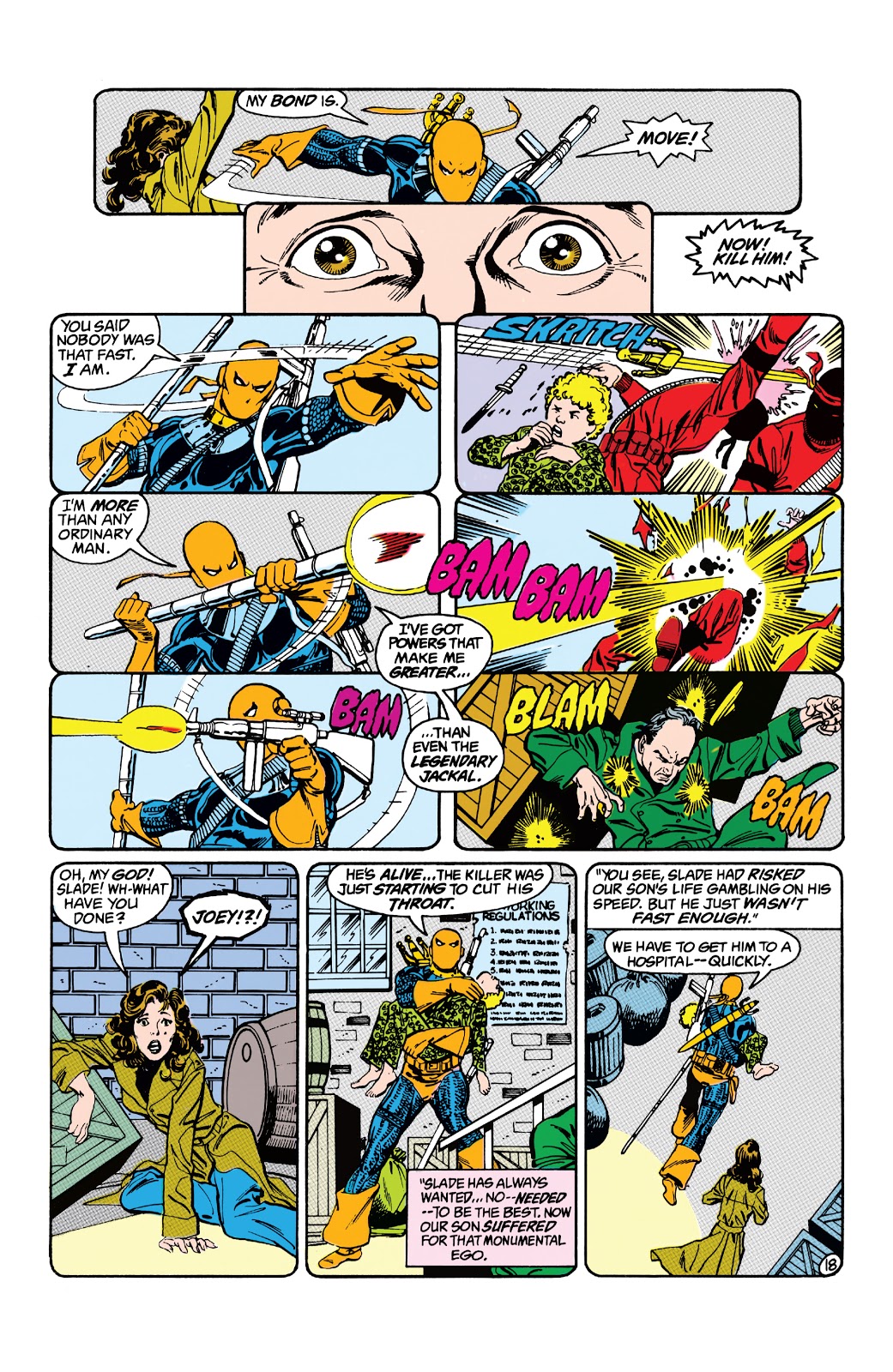
Slade and Adeline arrived at the rendezvous point where they met by Walsh, now a Uganda-based freelance terrorist known as the Jackal, along with more of his men. Slade knew the Jackal by reputation but did not recognize him from their Camp Washington days. The Jackal told Slade and Adeline that the ransom price for Joseph's safe return was not cash, but information. As one of his men pressed a bush-knife to young Joseph's throat, Walsh explained that his objective was to obtain the name of the person who hired Deathstroke to kill Col. Kabar. Adeline begged Slade to give up the name, but he refused to do it because it would violate his professional code of ethics to expose the identity of a client. Instead, he was confident that his enhanced abilities and mercenary skills would be enough to ensure Joseph's safe return.

Slade then sprung into action and quickly took down the Jackal's men. He then turned his attention to the Jackal. Deathstroke fired two bullets into the Jackal's torso. Unfortunately, Slade didn't act fast enough as Walsh's man had already begun to cut Joseph's throat as Slade's sword cut him down. Slade and Adeline rushed Joseph to the hospital, where his life was saved, but his vocal cords were too damaged to be repaired. Joseph would never be able to speak using his own voice again.

Slade gambled with his son's welfare and paid a heavy price.
Art by George Pérez 

While Joseph was recovering in the hospital, Slade prepared to leave once again as he had accepted a new contract. But before he could leave, Adeline confronted Slade about his lies, his secret life as a contract killer, and the consequences that those choices visited on their entire family. She was livid that Slade put his professional reputation as an assassin above the life of their son. Slade would hear none of it, determined to leave for his next assignment. As he turned around, Adeline aimed a gun in anger at the back of Slade's head meaning to end his life. As she fired the gun, Slade's enhanced reflexes allowed him to survive the attack, but at the cost of one of his eyes. As Slade lay unconscious, Adeline left him for dead. Once it was clear that he would live, Adeline took Joseph and Grant to start a new life without the danger and tragedy that Slade would inevitably bring to them.

Adeline Kane Wilson has had enough!
Art by George Pérez

Years later, Walsh would again target one of the Wilson boys to hurt Slade, but this time with devastating results. The international terrorist organization, H.I.V.E., attempted to hire Deathstroke to eliminated the Teen Titans. Slade refused the job, but H.I.V.E. was not done recruiting super-assassins. Slade's oldest son, Grant, had grown into an angry young adult with a serious hatred for the Teen Titans as he held them responsible for the relationship troubles with his girlfriend. An agent of H.I.V.E. convinced Grant that he could take his revenge on the Teen Titans by undergoing a procedure to give him power enough to destroy them. Grant accepted the offer and the contract from H.I.V.E., assuming the Deathstroke-inspired identity of the Ravager. After Grant fell short in his first battle with Cyborg, Deathstroke joined forces with his son for the showdown with the Titans. But as Grant was about to taste victory against the Titans, his body ultimately failed him as the procedure that created the Ravager caused him to age decades in just a few seconds. Because Slade blamed the Teen Titans for Grant's death, he assumed the contract on the Teen Titans and a vendetta was born. A number of years later, Slade would discover that the H.I.V.E. agent responsible for Grant's recruitment, and ultimate death, was none other than the Jackal, Bill Walsh.

In part two of this feature, we'll examine Walsh's final, and most personal assault on Deathstroke as he assumed Grant Wilson's Ravager persona, and nearly terminated the Terminator.

Wednesday, February 27, 2019

NIghtwing's Who's Who Entry from 1986

When Dick Grayson debuted in 1938's in the pages of Detective Comics (1937) #38, he originated the role of Batman's colorfully dressed teen sidekick, Robin. Grayson would carry this mantle until 1984's "The Judas Contract" story where he (along with Marv Wolfman and George Pérez) forged a new crime-fighting identity in Nightwing, during which his rivalry with Deathstroke really took off. I know that DC and Comixology recently re-released a digitally remastered version of the series, but posted below is a scan of the original 1986 Who's Who entry from issue #17 (XVII) featuring art by the Nightwing persona's co-creator, the legendary George Pérez.

Friday, February 8, 2019

The Terrible Tale of Marvel Comics' Death-Stroke

Yep, Death-Stroke just said that $#!+.
Art by Steve Leialoha
If imitation is indeed the sincerest form of flattery, then Marvel Comics writer, Chris Claremont must have really loved Deathstroke. In 1981, Claremont was more than five years into his seminal run on Uncanny X-Men (1963), which had experienced a revival and was one of the most popular and best selling comic book titles of the late 1970s and into the early 80s. 

But in the fall of 1980, Marv Wolfman and George Pérez relaunched DC Comics' Teen Titans with the New Teen Titans (1980). Wolfman and Pérez returned popular DC teen characters such as Robin, Wonder Girl, and Kid Flash in addition to a newly renamed Changeling, the angst-filled Cyborg, the dark and mysterious Raven, and the alluring alien sex-symbol, Starfire. And by issue #2, Wolfman and Pérez introduced an extremely charismatic, one-eyed, Terminator in blue and orange battle gear. The popularity of the New Teen Titans heroes (and a certain bad-ass villain) skyrocketed the title to the top of the sales charts and made itself serious competition to Claremont's band of mutant heroes.

By 1981, in addition to his duties on Uncanny X-Men, Claremont also wrote Marvel's Spider-Woman (1978) title. In Spider-Woman #39, Claremont decided to poke a little fun at his "distinguished competition" by lampooning Wolfman and Pérez's breakout villain, Deathstroke. Claremont's "master assassin," Death-Stroke (the hyphen means it's original), was contracted by Yakuza gangsters to murder Dan Ishima, a friend of Spider-Woman's alter ego, Jessica Drew. To assist Death-Stroke in his deadly work is his murderous crew of mercenary assassin named, the Terminators (that's correct: Death-Stroke and his Terminators). Once Spider-Woman arrived on the scene and engaged Death-Stroke in hand-to-hand combat, she made relatively quick work on him, despite his use of self-described "snazzy moves," and an always dangerous, "energy blade" that was capable of slicing a steel girder in twain. Death-Stroke would not make another appearance until his final one about a decade later in 1991 in the pages of Captain America (1968) #395 where he was killed while auditioning for a spot in the Red Skull's Skeleton Crew. That's right, Death-Stroke died during a job interview.

Whether it's his cleverly (?) hyphenated name or the ease of his defeat at the hands of Spider-Woman, Death-Stroke was clearly Claremont having a bit of fun at Wolfman, Pérez, and DC Comics' expense. Marvel apparently got the joke as evidenced by his ridiculous death. But I suppose as a parody character Death-Stroke isn't the worst I've seen. I mean he's no Red Tool...or Death Masque for that matter (I know; I'm sorry). In any event, enjoy the eight panels of glory that was Death-Stroke vs. Spider-Woman posted below.

Art by Steve Leialoha

Wednesday, February 6, 2019

THE TERMINATOR TAKEAWAY: Teen Titans: The Judas Contract (2017)

This post may be a few years too late, but I recently had the opportunity to re-watch DC Universe Animated Original Movies' 28th offering, 2017's Teen Titans: The Judas Contract. Unlike 90% of folks with much bigger digital platforms, I fully understand that I am not even remotely qualified to review films, so I'm simply going to treat this post as more of a commentary.

Teen Titans: The Judas Contract is an animated adaptation of Marv Wolfman and George Pérez classic 1984 Tales of the Teen Titans storyline of the same name (Tales of the Teen Titans #s 42 - 44 and Annual #3), and is also a continuation of the story that began in the 2013 DC animated film Son of Batman. Those of you who have not yet seen the film or are unfamiliar with the classic Judas Contract story may wish to stop reading this post now as spoilers will appear below.


SPOILERS BELOW!! SPOILERS BELOW!!


For those of us familiar with the source material, it is strange to see the Damian Wayne Robin and the Jaime Reyes Blue Beetle in this context, even though a verbal exchange between Damian and Deathstroke (recounting the events of Son of Batman) does seem to somewhat validate Robin's involvement. It is also puzzling that Brother Blood and his Chuch of Blood appear in this film as the church was merged with H.I.V.E. for no other reason than to justify Blood's role as the film's big bad rather than Deathstroke. It seems to me that the story would have a bit more emotional resonance were Deathstroke the main villain as he was in the source material, but then again I am biased toward Slade. Deathstroke's son, Jericho, was even relegated from an important character making his big debut, to a blink-and-you'll-miss-him Easter Egg, though this was somewhat remedied by a post-credits scene.

The central plot points of the original story are still present in this adaptation. A troubled Terra is taken into the Titans' fold, though most of the Titans, save a smitten Changeling/Beast Boy, are cautious of her stand-offish nature. Terra is revealed to the audience to be a traitor to the Titans in the service of Deathstroke. Though she is definitely enamored with Slade, her sexual advances are deflected by him as he strings her along with promises of a true and full relationship after the job of destroying the Teen Titans is done, unlike the original version where it is clear that their relationship is a sexual one. One hallmark of the comic's version of this story that was wonderfully recreated in the film was the iconic "super window jump" scene as Deathstroke crashed through a plate glass window to ambush Nightwing in his civilian identity leading to what was easily the best fight scene in the entire film.

Any analysis of this film would be incomplete without mentioning some key performances from the voice cast. Deathstroke was brilliantly brought to menacing life by the late character actor, Miguel Ferrer, in one of his final roles. The talented Christina Ricci also masterfully portrayed Terra as both heartlessly ruthless and emotionally fragile. Stuart Allan is also to be commended for making Damian Wayne, a character I personally find difficult to stomach, sympathetic and, dare I say, likable.

Teen Titans: The Judas Contract is a flawed film that at times suffers from being stuffed into a box of animated universe continuity that just doesn't fit. Story elements and characters that were randomly added, or fundamentally changed do little to contribute to the overall enjoyability of the film. But with the basic plot from the source material intact, strong voice performances for key characters, and some pretty cool action sequences, Teen Titans: The Judas Contract can still be a pretty fun way to spend a weekend afternoon.