Showing posts with label Deathstroke the Terminator (1991). Show all posts

Monday, June 17, 2019

DEATHSTROKE VS: The Janissary

The Janissary
Art by Gabriel Morrissette
In March of 1993, writer, Steven Grant stepped in for Marv Wolfman for four bi-weekly issues of Deathstroke The Terminator (1991). Grant's first issues (#s 22-23) made up a two-part story titled "The Quality of Mercy," in which Deathstroke was hired by a U.S. government agency to take down a Neo-Nazi leader named deHaan for kidnapping the son of an American diplomat and holding him prisoner at his militaristic compound. Slade, wary of the offer, ultimately accepted the job because he wanted to, in some way, make up for losing his own two sons. 

Slade managed to infiltrate deHaan's compound and free the boy but found himself confronted by deHaan. deHann claimed that he himself was working with the agency and begged for an explanation as to why he was being "burned," specifically mentioning a man named Campbell. But out of nowhere, the rescued boy shoots and kills deHaan before Slade could get any more information.

Slade was right to be suspicious of this job as the real purpose for his involvement in this operation was simply to flush the boy put into the open. Once the boy was free, the government agents killed him at their first opportunity. The same agents then tried to take out Slade in an effort to cover their tracks, but, being ridiculously overmatched by the Terminator, failed miserably. Having been both deceived and double-crossed on this job, Deathstroke was out for blood.

In Deathstroke The Terminator #23, once Campbell found out that his men failed to eliminate Deathstroke, and fearing for his life, he hired a young, "up-and-comer" assassin known only as the Janissary to terminate the Terminator. The self-professed "Top Five" mercenary, while recognizing the monumental task put to him, was so confident he could handle Deathstroke that he offered Campbell a money-back guarantee.

After a few days, Slade made his way to a Los Angeles Federal building to infiltrate the offices of the Defense Intelligence Agency. After tearing through the D.I.A., Slade kidnapped and "aggressively interrogated" Agent Shea in a secluded desert location until he learned where Campbell was holed up. By the time Slade returned to L.A. word was out that he was in town resulting in an unplanned car ride with an old government contact named Kleiner. Just as Slade explained to Kleiner that he and deHaan were set up by Campbell, the Janissary launched his first surprise attack on the Terminator.

Janissary getting the drop on Deathstroke.
Art by Gabriel Morrissette

After a short, but incredibly destructive melee on the streets of L.A., Slade made his escape as he felt that taking care of Campbell was a higher professional priority than dealing with the hotshot merc. Slade next boarded a train in an attempt to keep a low profile while zeroing in on Campbell's safehouse. Unfortunately for Slade, Janissary tracked him to the train and took a hostage demanding that Slade change into his professional gear so it wouldn't appear that he killed a normal "helpless fossil." Slade obliged and the two assassins left the train for their decisive battle, which is depicted below with art by Gabriel Morrissette.


After besting the Janissary, Slade showed uncharacteristic mercy toward him by allowing him to live. Though it was never explained in the story, it seemed that Slade probably saw a lot of his son Grant in the Janissary, which was probably a callback to the reasoning Slade used to accept the original job in Deathstroke The Terminator #22. It seems to me that this version of the Janissary would be a pretty intriguing foil for Deathstroke at some point in the future. He was shown to be skilled enough to hold his own against Slade hand-to-hand in this story, but add some time, experience, and a burning desire for a face-saving rematch and it could add up to a story I'd definitely be interested in reading.

On an unrelated note, is it my imagination or does this version of the Janissary bear a striking resemblance to Marvel Comics' Death-Stroke? I wonder if that was intended? Nah!

Marvel Comic's Death-Stroke and DC Comics' Janissary. Hmmmm.
Art by Steve Leialoha and Gabriel Morrissette

Friday, May 17, 2019

Deathstroke Animated Series to Air on CW Seed

A funny thing happened at this year's broadcast and cable television industry trade exposition, known as The TV Upfronts. During a live presentation to prospective advertisers, CW Network President, Mark Pedowitz announced that an animated series starring none other than Deathstroke is currently in development and was on its way to the CW Seed digital streaming platform. In the past few years, the CW Seed has a put together a strong track record of developing other animated series based on DC Comics' television properties such as Vixen (2015), Freedom Fighters: The Ray (2017), and Constantine: City of Demons (2018). Though unconfirmed, it is speculated that the animated series will draw its inspiration from the television version of Deathstroke that appeared in the CW's Arrow, which was portrayed by the fan-favorite actor, Manu Bennett.

A promo image for the animated Deathstroke series in development
for The CWSeed digital streaming platform.

Pedowitz was light on details like voice cast members or even a premiere date, but he did drop some interesting nuggets about the series premise. The show will "follow Slade [Wilson] as his family is threatened by the murderous villain Jackal and terrorist organization HIVE." It certainly sounds like the animated series' developers are borrowing heavily from Deathstroke's early appearances in New Teen Titans (1980) and the "Full Cycle" story arc from Deathstroke the Terminator (1991), all of which was written by Deathstroke's legendary co-creator, Marv Wolfman. If the image above is any indication, it appears that Deathstroke's look will resemble the bulky New 52/Arrow-style armor rather than the sleek and stealthy Ikon Suit. 

As more details about Deathstroke's CW Seed animated series emerge, you can be sure that The Deathstroke Files will bring them straight to you.

Wednesday, May 8, 2019

DEATHSTROKE COVERED: Deathstroke the Terminator (1991) #6 by Mike Zeck

For this edition of DEATHSTROKE COVERED, we turn to the 1991 cover to Deathstroke the Terminator (1991) #6 by Mike Zeck. This issue was the first chapter of the "City of Assassins" story arc that saw Deathstroke make his way to Gotham City to ferret out another assassin who was taking out Gotham mob bosses. What was special about this story was that it marked the first-ever confrontation between Deathstroke and Gotham's own Dark Knight, Batman. This landmark moment was not lost on Zeck as he rendered Deathstroke on a rooftop gargoyle, a usual haunt of Batman, in the middle of a storm-filled night. Deathstroke's pose beneath the specter of the Bat Signal conveys that he knows a confrontation with Batman is inevitable, but that he is more than ready to take down the Caped Crusader in his own city. Given the result of their first physical altercation, he was absolutely right to think so.

Art by Mike Zeck

Monday, April 22, 2019

DEATHSTROKE BY: Deathstroke The Terminator (1991) Artist, Steve Erwin!

For nearly a decade, from the mid-1980s to the mid-1990s, Steve Erwin was a mainstay artist for DC Comics. After a year working for First Comics, Erwin joined DC in 1987 to pencil the final three issues of Vigilante (1983). Erwin was then chosen to pencil the new series, Checkmate (1987) based upon the clandestine DC spy organization. After doing art for 25 issues of Checkmate, Erwin penciled various fill-in issues, one of which was the 1990 Deathstroke solo adventure in The New Titans (1984) #70, which served as a trial run for a future Deathstroke series. The issue was so well-received by fans that, the following year, Erwin was tabbed to launch Deathstroke the Terminator (1991) with Deathstroke co-creator, the legendary Marv Wolfman. Because of his work in this title, Erwin became the definitive Deathstroke artist for the early-to-mid 1990s penciling the landmark "Full Cycle," "City of Assassins," "Nuclear Winter," and "World Tour" storylines. Posted below are some pencil and ink pieces by Erwin that draw upon his Vigilante, Checkmate, and Deathstroke the Terminator past. As always, for best viewing results, open each image into its own tab.

An unmasked Deathstroke
Art by Steve Erwin

Peacemaker, Deathstroke, the Vigilante, and a Checkmate Knight
Art by Steve Erwin

DC Angels
 The Ravager, Vigilante, and Black Thorn
Art by Steve Erwin

Monday, March 11, 2019

RAVAGER ROLL CALL: Bill Walsh, aka The Jackal, Part Two

Ravager II
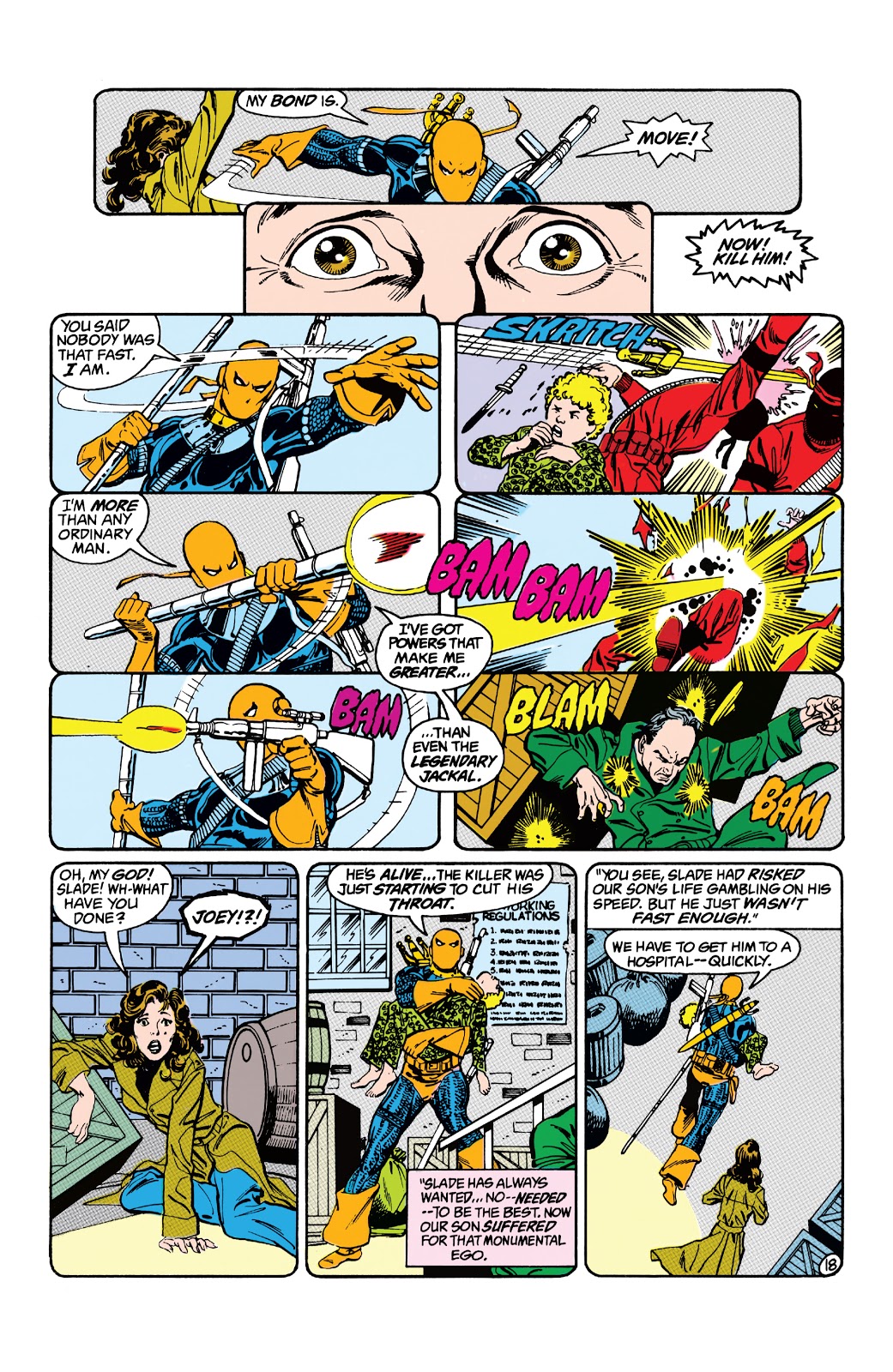
Last time on RAVAGER ROLL CALL, we were introduced to the man who would become the second Ravager. That man was Bill Walsh, aka the mercenary and freelance terrorist known as the Jackal. Walsh and Slade Wilson met while at the elite,  Camp Washington military training facility. Walsh soon resented Slade as he continually outshined him during training, and, according to Walsh, stole the affection of Adeline Kane, a trainer at Camp Washington. Walsh washed out of the program, but Slade not only stayed but married and had to sons with Adeline. Walsh moved on to assume the role of the terrorist, Jackal, while Slade volunteered for an experimental procedure that gave him his superhuman abilities. Slade used his new abilities to become the super-assassin and mercenary, Deathstroke the Terminator. Years later, Deathstroke and the Jackal would clash when Walsh kidnapped Slade and Adeline's youngest son, Joseph. All Walsh wanted was the name of one of Deathstroke's clients. Despite pleas from Adeline, Slade refused to give up his client and attempted to take down the Jackal and his entire crew. Though Deathstroke accomplished this feat, it was not in time to keep Walsh's man from cutting Joseph's throat. Furious that Slade hid his activities as Deathstroke and that he chose his professional ethics of the safety of his son, Adeline tried to kill Slade, but her shot only resulted in the loss of an eye. Adeline left Slade, taking both boys with her. And now...the rest of the story.

Years later after the events of "Titan's Hunt," Slade had every intention of retiring from the mercenary game to become a big game hunter in Kenya. Adeline had formed the organization, Searchers Inc. and was hired to safeguard a highly dangerous target. This job had her guarding a mystery object on a moving train that had departed from Stuttgart, Germany. Though she had a sizable amount of backup, a helmeted figure flying a single-seat helicopter engaged the security team and boarded the train. He then took out a crew of guards and stole a mysterious canister, which was the reason for such heavy security. The thief next climbed back on top of the train and advanced toward the train's engine. Once entering the engine, he shot the engineer and Adeline. The then addressed her by her name, telling her, "Long time, no see. See you still got your looks." He then grabbed her by her collar, told her to, "Say 'hi' to Slade for me when you see him in Hell," and then threw her from the moving train. He then boarded his copter and made his escape.

The second Ravager, in disguise, throwing a gut-shot Adeline from a
moving train.
Art by Steve Erwin.

At same the time Slade found out about Adeline, a helmeted figure was hovering over Slade's Kenyan hunting lodge taunting him over a loudspeaker. "Hi there, Slade. Been a damn long time. Slade, Buddy, thought you'd like to know your wench didn't even squeal when I gut-shot her." Slade and Wintergreen took cover in a Jeep and tried to draw the copter away from the house. The pilot didn't take the bait, instead, he unleashed a missile at the Jeep, turning it over. Slade reached his power staff and returned fire. Slade demanded to know who attacked him, but the loudspeaker only responded, "Your past, Wilson. But don't worry we'll meet again. It's our destiny." The copter then fired another missile, this time destroying Slade's hunting lodge, then made its getaway.

Slade and Wintergreen next made their way to Stuttgart to check on Adeline. But, Slade chose to leave when Adeline once again lost consciousness before she could give him any more information on her attacker. After doing a bit of...let's say aggressive investigative work, Slade discovered that the item stolen from the train was Plutonium. Meanwhile, the helmeted figure delivered the Plutonium to his client in the Quraci military. While this figure was receiving his next orders, he took off his flight suit to reveal another, more familiar one. This suit is almost identical to the one once donned by Grant Wilson. The mystery man then identifies himself as the Ravager.

After some more aggressive investigation, Slade discovered that his mystery attacker was working for General Avral Kaddam, the newly ascended Quraci leader, and likely delivered the Plutonium there. Deathstroke and Wintergreen journeyed to civil war-torn Qurac and met up with a contact they had inside the rebel forces. Once he got the schematics of the General's compound from the rebels, Deathstroke then infiltrated the general's headquarters figuring that Adeline's attacker would be there. Even though Slade was right, the newest Ravager had laid a trap from him there.

Deathstroke ambushed by the
Ravager
Art by Steve Erwin
As Deathstroke maneuvered through the general's compound, the Ravager opened fire, ambushing Slade. While Slade was recovering, the Ravager revealed himself, wearing a version of Grant Wilson's old suit. The shock of this image threw Slade off of his game as the two mercs engaged one another. The Ravager taunted Slade by claiming that he was in fact Grant seeking revenge on his father.  Slade regained his composure and after a savage physical exchange, Deathstroke took the upper-hand and was about to slay the Ravager, only for General Kaddam to shoot Slade in the back, thus saving the Ravager. As Kaddam was about to finish Deathstroke, the Ravager convinced Kaddam not to kill Slade as he still needed for Deathstroke to suffer. As the rebels drew closer to taking the base, Kaddam and the Ravager tried to make their exit, but they were pinned down as Wintergreen had arrived to try to protect Slade. But as Wintergreen descended the steel staircase, the Ravager opened fire bringing the metal structure down and Wintergreen with it. After the Ravager and Kaddam had fled, U.S. forces came onto the scene taking an unconscious Deathstroke and Wintergreen into custody as the Ravager had a man inside the CIA that framed Slade for treason for supposedly backing General Kaddam instead of the U.S. backed rebels in the Quraci civil war. Meanwhile, after some time had passed, the Ravager is shown on the deck of a sailboat that has been loaded with the stolen Plutonium, with the unmistakable view of Washington D.C. in the background.

Slade played possum as he and Wintergreen were being transported by U.S. forces. Slade noticed that his guards' commanding officer was wearing a ring with the Ravager's logo on it. Understanding his dire situation, Slade sprung into action, taking down his captors and escaping into war-torn Qurac. Meanwhile, the Ravager and General Kaddam were leading a crew of men preparing to detonate a nuclear device at the site of trade treaty signing by the U.S. President. General Kaddam laments that had Deathstroke not interfered in his plans, that they would have had enough Plutonium to bomb multiple treaty signings around the world simultaneously and send the message to the rest of the world that he, and not the West, was in control of the Middle-East. 

When Slade reached in Washington he prepared to confront to Kaddam and the Ravager as they were moving on the Senate house. The two killed their way to the underground tram system that links the Senate house to the Capitol Building where they planned to set the nuclear device to destroy Washington D.C. and stop the treaty signing. As Deathstroke arrived he began tearing through Kaddam's forces as he pursued the terrorist pair. Kaddam panicked when he heard the distant screams of his dying men and broke for the tram to set the bomb in place. But before Kaddam reached the tram, the Ravager, using Deathstroke's stolen power staff, shot him in the back, killing him while declaring that, "I can't let you screw up my plans."

The Ravager reveals his true motive.
Art by Steve Erwin.

As Slade reached the Ravager, he was disarmed by a blast from his own power staff. The Ravager then revealed himself to Deathstroke, but at first glance, Slade didn't recognize him. After the Ravager mentioned Camp Washington, Slade realized that he was looking at his old classmate, Bill Walsh. Walsh explained that he blamed Slade for ruining his chances with Adeline and for his washing out of Camp Washington. As the two mercenaries engaged in swordplay, Walsh reminded Slade of their previous encounter the night that Joseph Wilson was muted by a knife to the throat. Slade then understood that Walsh and the Jackal were the very same man. This revelation enraged Slade to the point that his emotions were compromising his concentration and fighting technique, allowing the Walsh to take the upper hand in the fight. Walsh explained that though he took two bullets to the chest that night, he survived. It took nearly two years for Walsh to recover, but when he did, he planned his revenge against Deathstroke. 

Walshes next revelation was equally devastating for Slade as he admitted to being the H.I.V.E. agent who recruited Grant Wilson to undergo the very procedure that allowed him to become the first Ravager, which ultimately killed him during his failed attempt to kill the Teen Titans. Walsh claimed to have known the procedure would be fatal and that recruiting Grant was no coincidence, but instead was calculated revenge against Slade. As the two killers continued to fight, Kaddam's nuclear device beeped, indicating that it was armed. Walsh declared that he never intended to leave their confrontation alive and that they would both go out in thermonuclear glory. But as Walsh gloated about his impending victory over Slade, Deathstroke managed to ironically slice Walsh's throat with his sword. As Slade prepared to deliver the literal death-stroke, Walsh managed to kick him off the platform and onto the tram tracks. Walsh jumped down to the tracks as well to finish Slade. As the two old soldiers grappled for Walsh's sword, Slade wrestled it away from Walsh and plunged it deep into his abdomen, fatally wounding him. As life took its leave from Walsh's body, Slade ran the blade in even deeper. The last words Walsh ever heard were the ones in which Slade exclaimed that because of all the pain Walsh had caused his family, that "I can't kill you enough." While the immediate threat posed by Walsh was over, Slade remembered that the nuclear was still set to go off. Slade reached the device with 10 seconds left on the timer. As Slade frantically pulled multi-colored wires away from their connections, the timer stopped with but single second to spare.

The epic climax of Deathstroke versus the Ravager is posted below. Art by Steve Erwin.


Saturday, March 2, 2019

RAVAGER ROLL CALL: Bill Walsh, aka The Jackal, Part One

Art by Steve Erwin
In this edition of the Ravager Roll Call, the focus is on the second Ravager, Bill Walsh, aka the Jackal, who played critical roles in the grim history of the Wilson family. Slade Wilson and Walsh met decades ago during their training days at the top military school,  Camp Washington. Walsh's rivalry with Slade began simply enough as both men were strongly attracted to one of their trainers, Captain Adeline Kane. Walsh claimed that he and Adeline were "becoming an item," when Slade's arrived at the camp, but Adeline and Slade eventually fell for one another, thus leaving an exceedingly jealous Walsh out in the cold. Walsh further resented Slade because of his uncanny aptitude for combat and military tactics, which made Walsh's skills look ordinary by comparison. In time, Walsh washed out of Camp Washington for which he blamed Slade for humiliating him to the point that his reputation was destroyed and his military career came to an end. 

Years later, after Slade had established himself as the world's deadliest assassin, Deathstroke the Terminator, he and Walsh clashed again resulting in a tragedy that would scar the lives of the entire Wilson family forever. Slade operated as Deathstroke for years without ever sharing this side of himself with his then-wife, Adeline or his sons, Grant and Joseph. One of the Terminator's many confirmed kills was powerful Quraci colonel named Akba Kabar. While Slade was away from home on a job, a crew of identically dressed mercenaries attacked the Wilson home. Drawing upon her military past, Adeline fought off the Jackal's men, but not before one of them launched a gas grenade rendering her unconscious. When she awoke, Adeline discovered that her youngest son, Joseph had been kidnapped.

When Slade returned home, it was evident that he was aware of the attack as he knew exactly how to contact the kidnapper to arrange a face-to-face meeting. With the arrangements finalized, Slade donned his professional gear and revealed himself to his shocked and distraught wife to be Deathstroke the Terminator. Adeline pleaded with Slade to do whatever it took to bring Joseph home safe.

Enter the Jackal
Art by George Pérez

Slade and Adeline arrived at the rendezvous point where they met by Walsh, now a Uganda-based freelance terrorist known as the Jackal, along with more of his men. Slade knew the Jackal by reputation but did not recognize him from their Camp Washington days. The Jackal told Slade and Adeline that the ransom price for Joseph's safe return was not cash, but information. As one of his men pressed a bush-knife to young Joseph's throat, Walsh explained that his objective was to obtain the name of the person who hired Deathstroke to kill Col. Kabar. Adeline begged Slade to give up the name, but he refused to do it because it would violate his professional code of ethics to expose the identity of a client. Instead, he was confident that his enhanced abilities and mercenary skills would be enough to ensure Joseph's safe return.

Slade then sprung into action and quickly took down the Jackal's men. He then turned his attention to the Jackal. Deathstroke fired two bullets into the Jackal's torso. Unfortunately, Slade didn't act fast enough as Walsh's man had already begun to cut Joseph's throat as Slade's sword cut him down. Slade and Adeline rushed Joseph to the hospital, where his life was saved, but his vocal cords were too damaged to be repaired. Joseph would never be able to speak using his own voice again.

Slade gambled with his son's welfare and paid a heavy price.
Art by George Pérez 

While Joseph was recovering in the hospital, Slade prepared to leave once again as he had accepted a new contract. But before he could leave, Adeline confronted Slade about his lies, his secret life as a contract killer, and the consequences that those choices visited on their entire family. She was livid that Slade put his professional reputation as an assassin above the life of their son. Slade would hear none of it, determined to leave for his next assignment. As he turned around, Adeline aimed a gun in anger at the back of Slade's head meaning to end his life. As she fired the gun, Slade's enhanced reflexes allowed him to survive the attack, but at the cost of one of his eyes. As Slade lay unconscious, Adeline left him for dead. Once it was clear that he would live, Adeline took Joseph and Grant to start a new life without the danger and tragedy that Slade would inevitably bring to them.

Adeline Kane Wilson has had enough!
Art by George Pérez

Years later, Walsh would again target one of the Wilson boys to hurt Slade, but this time with devastating results. The international terrorist organization, H.I.V.E., attempted to hire Deathstroke to eliminated the Teen Titans. Slade refused the job, but H.I.V.E. was not done recruiting super-assassins. Slade's oldest son, Grant, had grown into an angry young adult with a serious hatred for the Teen Titans as he held them responsible for the relationship troubles with his girlfriend. An agent of H.I.V.E. convinced Grant that he could take his revenge on the Teen Titans by undergoing a procedure to give him power enough to destroy them. Grant accepted the offer and the contract from H.I.V.E., assuming the Deathstroke-inspired identity of the Ravager. After Grant fell short in his first battle with Cyborg, Deathstroke joined forces with his son for the showdown with the Titans. But as Grant was about to taste victory against the Titans, his body ultimately failed him as the procedure that created the Ravager caused him to age decades in just a few seconds. Because Slade blamed the Teen Titans for Grant's death, he assumed the contract on the Teen Titans and a vendetta was born. A number of years later, Slade would discover that the H.I.V.E. agent responsible for Grant's recruitment, and ultimate death, was none other than the Jackal, Bill Walsh.

In part two of this feature, we'll examine Walsh's final, and most personal assault on Deathstroke as he assumed Grant Wilson's Ravager persona, and nearly terminated the Terminator.

Friday, September 9, 2016

Why Pick Deathstroke For Affleck's Batman Movie? Because This!

I was talking to a young comics fan the other day who didn't understand why the internet was quote, "crapping their pants about Deathstroke," after the now famous Affleck Tweet. "That old guy from Arrow, right?" he asked. "That's pretty weak bro," he said. He hadn't played Arkham Origins, but had played Arkham Knight, which left him less than impressed with Mr. Wilson. I then showed him the same five images that I'm posting below from Deathstroke the Terminator (1991) #7, which he had never read before. After a literal double take, the young man simply responded with, "Dog, that's sick!" I don't know for sure, but I think that I (like Deathstroke) won.


Saturday, August 27, 2016

Enter, Gunfire...I Don't Know Why

Gunfire! Because the comic book crash
of the 90s wasn't happening fast enough
for DC.
In the history of comic books, the 1990s was a decade defined by volatility, controversy, and a level of consumer gluttony that created a market bubble that almost killed the entire industry. During the run up to the comics crash, market speculators had mistakenly identified comic books as a cheap investment that would payoff in a big way like many of the golden age books did. These speculators either completely ignored, or more likely were oblivious to the facts that the golden age books appreciated in value not only because they featured the first appearances of iconic characters, but that they were extremely scarce due to paper rationing of the WWII years and the SHORT-SIGHTED IDIOCY OF PARENTS WHO MADE THEIR KIDS THROW THEM AWAY FOR COMPLETELY RIDICULOUS REASONS LIKE CLUTTERED BEDROOMS OR POTENTIALLY ARRESTED SOCIAL AND EMOTIONAL DEVELOPMENT... AAAARRRRGGGGHHH!!! (I'm Ok, really.) In response to the speculator-driven consumer glut on comic books, publishers (mistaking the building market bubble for a real and sustainable increase in demand) introduced features designed to further boost comic book sales by encouraging consumers to purchase multiple copies of the same issue including multiple/variant covers and gimmick covers (i.e. die-cut, chromium, hologram covers, and so on). Furthermore, publishers also vastly increased the total number of titles they offered, which unfortunately featured many characters and teams that ultimately had little or no staying power, essentially diluting the quality of the overall product. DC Comics was front and center in the coming comics quagmire as exemplified by its 1993 Summer comics event, Bloodlines.

Bloodlines was a Summer event that ran through 23 DC Comics annuals and concluded with a two issue mini-series. The plot was simple; seven shape-shifting alien parasites came to Earth and fed on the spinal fluids of random humans, killing them in the process. However, 23 of their victims possessed the metagene, which was triggered by the attacks, giving rise to 23 new metahumans, known as "New Bloods" into the DC Universe. More importantly to DC, it created 23 potential new solo titles and maybe even one new team book. Unfortunately for DC only seven new titles were launched out of the Bloodlines event and six of them were short-lived. Only Hitman, from The Demon (1990) Annual #2, enjoyed any real success with a solo title running from 1996-2001 by Garth Ennis and John McCrea. 

Deathstroke explains Gunfire's powers,

The sales juggernaut that was introduced in Deathstroke: The Terminator (1991) Annual #2, was Gunfire, whose own solo series lasted a whopping fourteen issues. Created by comics legend Len Wein and Steve Erwin, Gunfire was Andrew Van Horn, the son of Gunther Van Horn, owner of the Paris-based weapons manufacturer, Van Horn Industries. The alien parasite, Venev, found herself in Paris and was drawn to Slade Wilson, who came to Paris to acquire new armor and weapons from his old friend Gunther. Following Slade to Van Horn Industries, Venev went on a feeding rampage slaughtering numerous people including Gunther and seemingly Andrew. Andrew, however, had the metagene which was activated as a result of Venev's bite. Andrew had gained the ability to "agitate" the molecules of objects that he touches with his hands and then to project those molecules into gunfire-like blasts (Think the X-Men's Gambit only he doesn't have to throw anything). Long story short; he teamed up with Deathstroke to defeat Venev, had a short-lived solo title, joined other New Bloods in the short-lived Blood Pack team, survived both the Infinite and Final Crises, had his hands cut off by Prometheus, and after Flashpoint he somehow became an African-American police detective named Blake (Dr. Manhattan?!?) That's about it.

Sunday, August 21, 2016

Deathstroke vs. Deadshot: Part 1

Floyd Lawton: Deadshot
Deadshot, the professional name of assassin Floyd Lawton, debuted in 1950 in the pages of Batman (1940) #59. The year 2016 marked Deadshot's coming-out party to the general public with the recent release of Suicide Squad in theaters worldwide. Will Smith's portrayal of the world's best marksman even meet with some critical praise. Given the nature of their chosen profession, it seems only natural that Deathstroke and Deadshot would cross paths from time to time, leaving a trail of blood behind them. This feature will take a look at some of these bullet-filled confrontations.

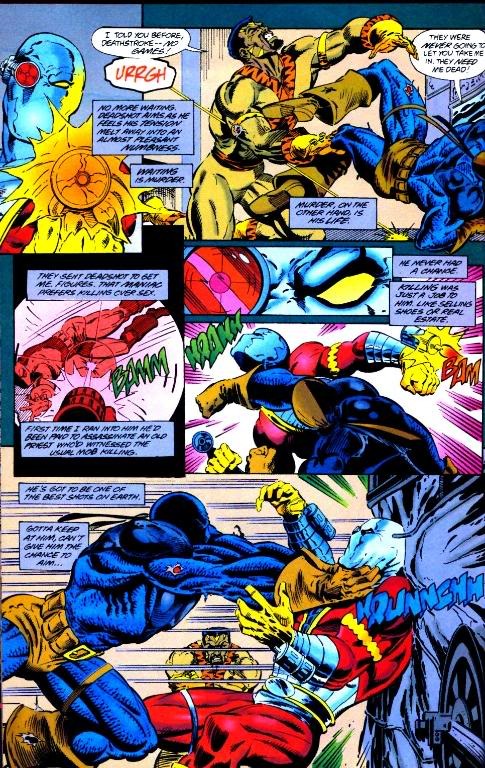
Our first stop on our tour of blood between these two super-assassins takes place in Deathstroke: The Terminator (1991) #41. In part two of the "Deathstroke The Hunted" storyline, Slade Wilson finds himself on the run, framed for a crime of which he has no knowledge. With people coming out of the woodwork to bring him in, Deathstroke finds himself confronted by not one, but two of the world's deadliest men, the Bronze Tiger and Deadshot. Thought Deathstroke had the upper-hand against Deadshot in close-quarters combat, the interference of Bronze Tiger complicated matters greatly for Slade. Slade took Deadshot to the ground, but while distracted by Tiger, Deadshot opened up his wrist guns on Deathstroke at close range ending the confrontation. This battle is depicted below. Round One goes to Deadshot, but with a huge assist to Bronze Tiger.


Another confrontation took place in Secret Six (2008) #6, even though it was pretty short. This was little more than a deadly form of a game of chicken with neither killer "winning."


Two battles between the two master assassins with no decisive victor. But both of these battles took place prior to Flashpoint. In part two of this feature, I'll take a look at more confrontations between Deathstroke and Deadshot, featuring some within the New 52.

Tuesday, August 9, 2016

Deathstroke in the House...Ad

Check out Deathstroke's first feature house ad from 1991 promoting the launch of Slade's first ever solo title: Deathstroke the Terminator (1991) written by Deathstroke co-creator, Marv Wolfman with art from Steve Erwin and Will Blyberg. The ad ran in both black and white, and in full color utilizing the cover art from issue #1 by the series' cover artist Mike Zeck.  Both versions are pictured below.


Monday, August 8, 2016

Deathstroke's Blue Period(s)

The great Spanish artist Pablo Picasso was known for his "Blue Period" in which most of his work was dominated by the color blue. Oddly enough, Deathstroke the Terminator also had his "Blue Period." In fact, he's had several of them. On multiple occasions, Slade dropped the familiar blue and orange getup and switched to blue and silver gear. So, let's take a short trip through Deathstroke's Blue Period(s).

The "Nuclear Winter" storyline in Deathstroke the Terminator (1991) #s 17-20 is our first stop. Deathstroke was dead (for the nth time) and his body was recovered by the Cheshire-led Brotherhood of Evil. Cheshire and company nurse him back to health and in payment for such a service, he has to join them. For whatever reason, Cheshire dresses Slade up in the costume you see below. He wasn't in this costume long, but it was long enough to be the look used for his DC Cosmic Teams trading cards.


Then, toward the end of "The Borgia Plague" storyline, Slade is caught in an explosion that all but destroyed his body. He somehow survived this, but lost his memories in the process. However his metahuman healing ability, pushed to the extreme (90s reference) to rebuild his broken body worked so hard that in addition to healing his injuries, it de-age him about 20 or so years worth. As part of his new start in life, as shown in the "Night of the Karrion" storyline, Slade adopted the blue costume pictured below. Notice the armor is absent from his chest and abdomen regions, but his shoulders, knees, shins, and crotch (Priorities, man!) are ready for combat. Deathstroke held onto this look for about three years.


The blue and silver look even made an appearance in the New 52 as Rob Liefeld revived it for an origin tale in Deathstroke (2011) #0, which is pictured below. Thankfully for us, Slade came to his senses and adopted the familiar blue and orange look we've all come to know.